From the Classroom to the Crib
My Journey from Teacher to Sleep Consultant & Founder of Kidz Under Construction
By Barbara Ross
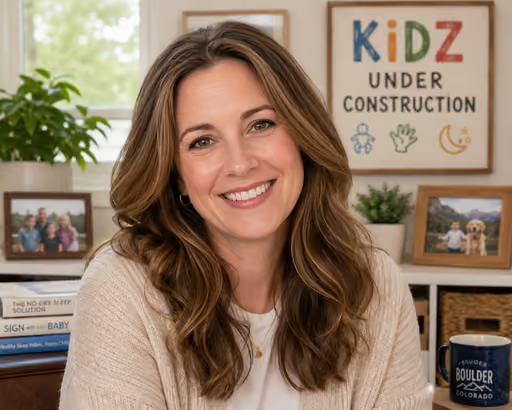
There's a version of this story that starts with a sleep-deprived mother sitting on the floor of a nursery at 2 AM, rocking a wailing baby and quietly falling apart.
That part is real. And I'll get there.
But the real beginning — the thread that explains everything — starts much earlier. It starts in a classroom.
Before the Business, There Was a Teacher
Long before I was a sleep consultant, before I had children of my own, before Kidz Under Construction existed as anything more than an idea I hadn't had yet — I was a teacher.
I spent my early career in Catholic schools and with Christian missionary programs, working with children at their most formative, most impressionable stages. These weren't high school students trying to figure out who they were. These were little ones — the under-fives, the kindergarteners, the first-graders — children whose minds were still being assembled, whose emotional worlds were still taking shape.
And I watched all of it, closely.
I noticed which children struggled to express what they needed and how that frustration spilled out in ways that looked like behavior problems but were really just communication gaps. I noticed how a child who felt heard was a calmer child. A more curious child. A child who could learn. I noticed how sleep — or the lack of it — showed up in every corner of a child's day, in their attention span, their emotional regulation, their willingness to try something hard.
None of this was research I was reading at the time. It was observation. Pattern recognition. A teacher's sixth sense, built one classroom at a time.
That early instinct — that something is always going on beneath the surface with young children, and if you pay close enough attention you can find it — quietly followed me out of every classroom I ever stood in, and eventually led me somewhere I didn't expect.
The Degree, the Dream, and the Long Road Between Them
I graduated from the University of Colorado Boulder with a degree in Early Childhood Education. I chose that path deliberately — not because it was practical, but because I genuinely could not imagine caring about anything more than this: how children grow, how they learn, and what they need to do both well.
I built a life in Boulder, Colorado, surrounded by mountains and community. I married Michael. I kept teaching. I kept noticing. And somewhere in those years, the curiosity I'd carried since my missionary school days began to sharpen into something with more edges — more questions I wanted real answers to.
What actually helps young children communicate before language arrives? What does the science say about infant sleep? What do parents actually need that nobody is giving them?
The answers were out there. I just hadn't started looking for them in earnest yet.
That changed when Emma arrived.
Emma Changed Everything
When my first daughter was born, I — educator, trained child development professional, woman who had spent a decade watching other people's children — was completely, utterly overwhelmed.
I laugh about it now, a little. The irony is not lost on me. Here I was, having studied early childhood development at a university level, having spent years in classrooms and community programs supporting young children, and yet my own baby left me feeling like I knew absolutely nothing.
The early months were hard. Emma's sleep was unpredictable. Night wakings were relentless. She would fuss and cry, and I would run through every checklist I could think of — fed? changed? warm enough? — and still not know what she needed. There was a particular helplessness in watching your baby be frustrated and not being able to understand why.
The former teacher in me recognized the pattern immediately: this was a communication problem.
Emma couldn't tell me what was wrong. She didn't have words yet. And I, who had spent my career building bridges between children and understanding, felt that gap more acutely than I ever expected.
I read everything I could find. I discovered Elizabeth Pantley's The No-Cry Sleep Solution and felt, for the first time, like someone was speaking directly to me — not prescribing rigid schedules or advocating for methods that felt wrong in my gut, but offering something gentler. More respectful. More aligned with who I was as both a mother and an educator.
Around the same time, a friend mentioned baby sign language.
The Moment That Lit the Fire
I started signing with Emma. Simple signs at first — milk, more, all done. I wasn't sure it would work. I did it anyway, consistently, every day, the way a teacher would: with patience, with repetition, with faith that something was being absorbed even when I couldn't yet see it.
And then one day, Emma signed back.
Milk.
I still think about that moment with something close to reverence. It wasn't just that she had learned a sign. It was what happened next. The frustration dropped. The frantic crying softened. Emma had a way to reach me that didn't require screaming into the void — and she used it. Over and over. The communication gap that had felt so unbridgeable began to close, one small sign at a time.
And something else happened too, something I hadn't entirely predicted: Emma's nights got better.
Not immediately. Not magically. But measurably, meaningfully better. A baby who could communicate her needs during the day seemed to carry less unspent frustration into the night. I had suspected this connection existed — I'd felt it intuitively from my years in education — but now I was living it.
The former teacher in me didn't just feel relief. She felt certainty.
This is real. This works. And other parents need to know about it.
Building Something, Class by Class
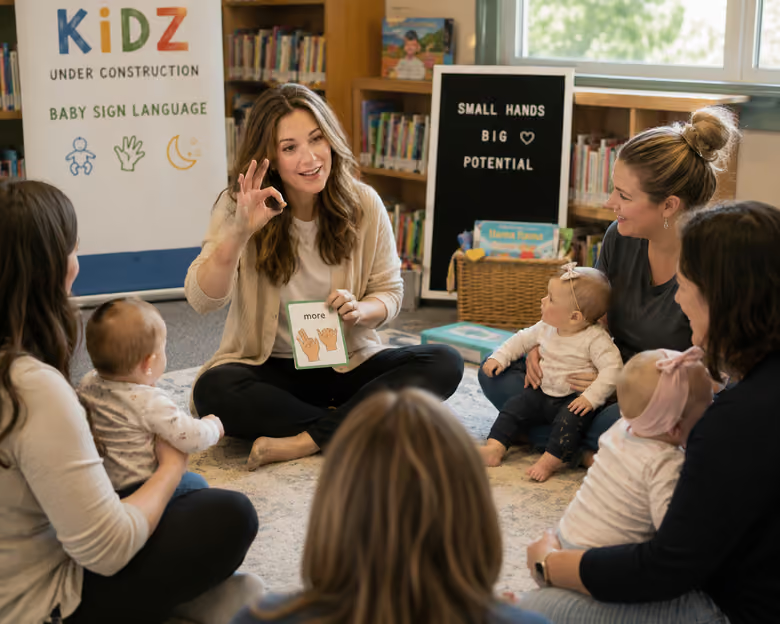
In 2013, I became a certified Sign2Me Instructor through Dr. Joseph Garcia's SIGN with your BABY® program — the same program rooted in American Sign Language research that had informed so much of what I'd been doing instinctively at home.
I started teaching.
Not in a polished studio. Not with a website or a brand or a business plan. I started the way most genuine things start — in the spaces where parents already were. Libraries. Pediatric offices. Hospital newborn classes. Community centers dotted across the Colorado Front Range.
I showed parents, grandparents, nannies, and childcare providers how to communicate with preverbal infants and toddlers. I taught them the signs. I taught them the patience. I taught them to watch for the baby's first attempt — a clumsy, approximate little hand shape that meant I'm trying to talk to you — and to celebrate it like the miracle it was.
The joy on parents' faces the first time their baby signed back never got old.
Not once, not in twelve years, not after teaching thousands of families across Colorado and eventually through an online course I developed so parents anywhere in the world could access the same tools. The moment a parent sees their baby communicate intentionally for the first time — that moment belongs to something bigger than a business.
Jacob arrived in 2017, my second child, and I signed with him from day one. Watching him sign before he could speak felt like watching a small person unfurl — like seeing him realize I have something to say and people can hear me. I knew then that I wanted to keep doing this work for a long, long time.
The Second Chapter: Sleep
When Sophia was born in 2022, my youngest, our family was different. More experienced, yes. But also more honest about how genuinely hard early parenthood is, no matter how many times you've done it.
Sophia went through a significant separation anxiety phase. The nights were rough again in new ways. And I — now a decade into my work with families, deeply familiar with how sleep and communication intertwine — felt something shift.
I had been helping parents with baby sign language for years. But parents kept coming to me with sleep questions too. They knew I understood babies in a way that felt different from what they found online. They trusted me. And I kept pointing them toward resources rather than being the resource myself.
It was time to go deeper.
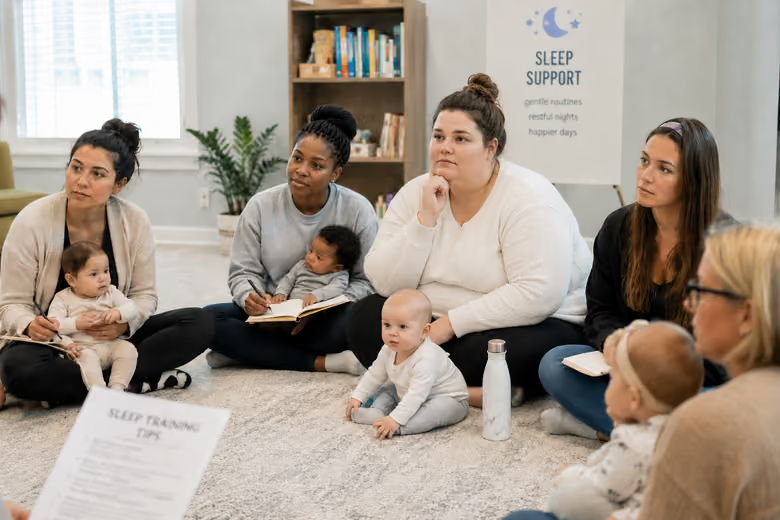
I enrolled in the Pediatric Sleep Parenting Institute and became a certified Pediatric Sleep Consultant. I brought to that certification everything I had already spent a decade learning in the field: the importance of individualized approaches, the connection between a child's communication abilities and their sleep patterns, the reality that there is no one-size-fits-all answer for families who are all beautifully, stubbornly different.
Emma's early sleep battles. Jacob's reflux-related night wakings. Sophia's separation anxiety. Three children, three entirely different challenges, three entirely different paths to better nights. I had lived all of them.
That breadth of lived experience — alongside my formal training and my decade-long professional practice — became the foundation of everything Kidz Under Construction would grow into.
What It Took to Build This
Building a consulting business is not a straight line. It is a series of small decisions that don't feel significant at the time and only make sense in hindsight.
It was the decision to teach that first library class even when I wasn't sure anyone would show up. It was the decision to keep going when someone did. It was learning to talk about what I do without apologizing for it — learning that "I help babies sleep and I teach families to sign" was not a small thing. It was a necessary thing, an important thing, a thing that changed the texture of family life for people who desperately needed it.
It was learning to trust my instincts — the ones I first developed in those early classroom years when I was just a young teacher paying attention to small children and noticing things other people walked past. Those instincts were never wrong. They just needed time — and training, and courage — to become something I could offer to the world.
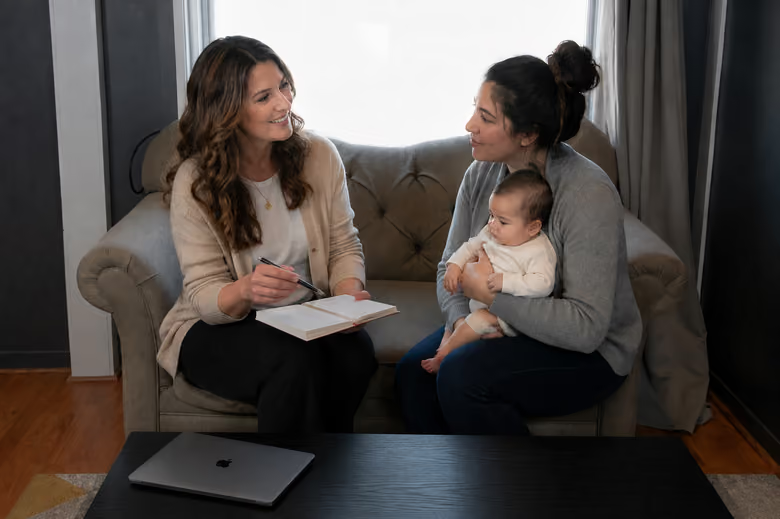
It was assembling a team. I knew my approach could go further with people alongside me who brought what I couldn't — NICU nursing experience, holistic sleep philosophy, perinatal mental health expertise. I found Mary, and Dolly, and Nancy, and recognized in each of them the same thing I recognized in myself: a person who had been changed by this work, who could not imagine doing anything else.
Kidz Under Construction is what it became because of all of that. Not just the certifications. Not just the credentials. But the curiosity that started in a Catholic school classroom, the observation that never stopped, the fire that was lit by one baby signing milk for the first time, and the quiet, determined, decade-long act of showing up for families who needed someone in their corner.
What Motivates Me Still
People ask me sometimes what keeps me going after twelve years of this work. I don't have to think about it for very long.
It's the message I get at 7 AM from a parent who says their baby slept through the night for the first time. It's the video a grandmother sends of her eighteen-month-old grandson signing I love you across the kitchen. It's the father who emails to say he finally feels like he understands his baby — not because the baby can talk yet, but because they've found a language between them.
It's the thing I've known since I was a young teacher standing at the front of a classroom: that when children feel understood, when the gap between what they need and what they can express gets smaller, something fundamental shifts. They're calmer. More curious. More connected to the people who love them.
That has never stopped being worth showing up for.
To You, Reading This
If you found your way here because you're in the thick of it — sleepless nights, a frustrated baby, the creeping feeling that you must be missing something everyone else seems to know — I want you to hear this directly:
You're not missing anything. This is just hard. It's hard for everyone, including people who study it for a living.
What I've learned across twelve years of working with families — and three children of my own — is that there is almost always a way through. It usually doesn't look like what you read on the internet. It looks like understanding your specific baby, your specific family, and finding the approaches that actually fit.
That's what I'm here to help you do.
Every child is under construction. So is every parent. You don't have to figure this out alone.
— Barbara